

The Fear Underneath This Question
Your child does not want to go back. Maybe they have said it outright. Maybe they have cried, or shut down, or simply refused to get out of the car in the school drop-off line.
And you are caught between two fears that feel like they are pulling in opposite directions. One fear is for your child's wellbeing — sending them back into a place that has hurt them. The other fear is about the law — compulsory attendance requirements, truancy, the worry that keeping them home will somehow turn the spotlight onto you as the parent.
Here is what I want you to understand clearly: whether keeping your child home looks like a violation depends entirely on how you document and communicate the absence with the school. It is not about whether you keep them home. It is about how that decision is recorded.
What I See Parents Get Wrong
The most common mistake I see is parents keeping their child home and simply not telling the school why — or telling the school informally, through a quick phone call or a vague note, without creating a real written record.
Compulsory attendance laws exist, and they matter. But they are not designed to punish a parent who is protecting their child from harm and communicating clearly about it. They are designed to address unexplained, undocumented absences. The difference between those two situations is entirely about documentation.
Silence is what creates the appearance of a violation. Clear, written communication is what protects you.
What to Communicate to the School
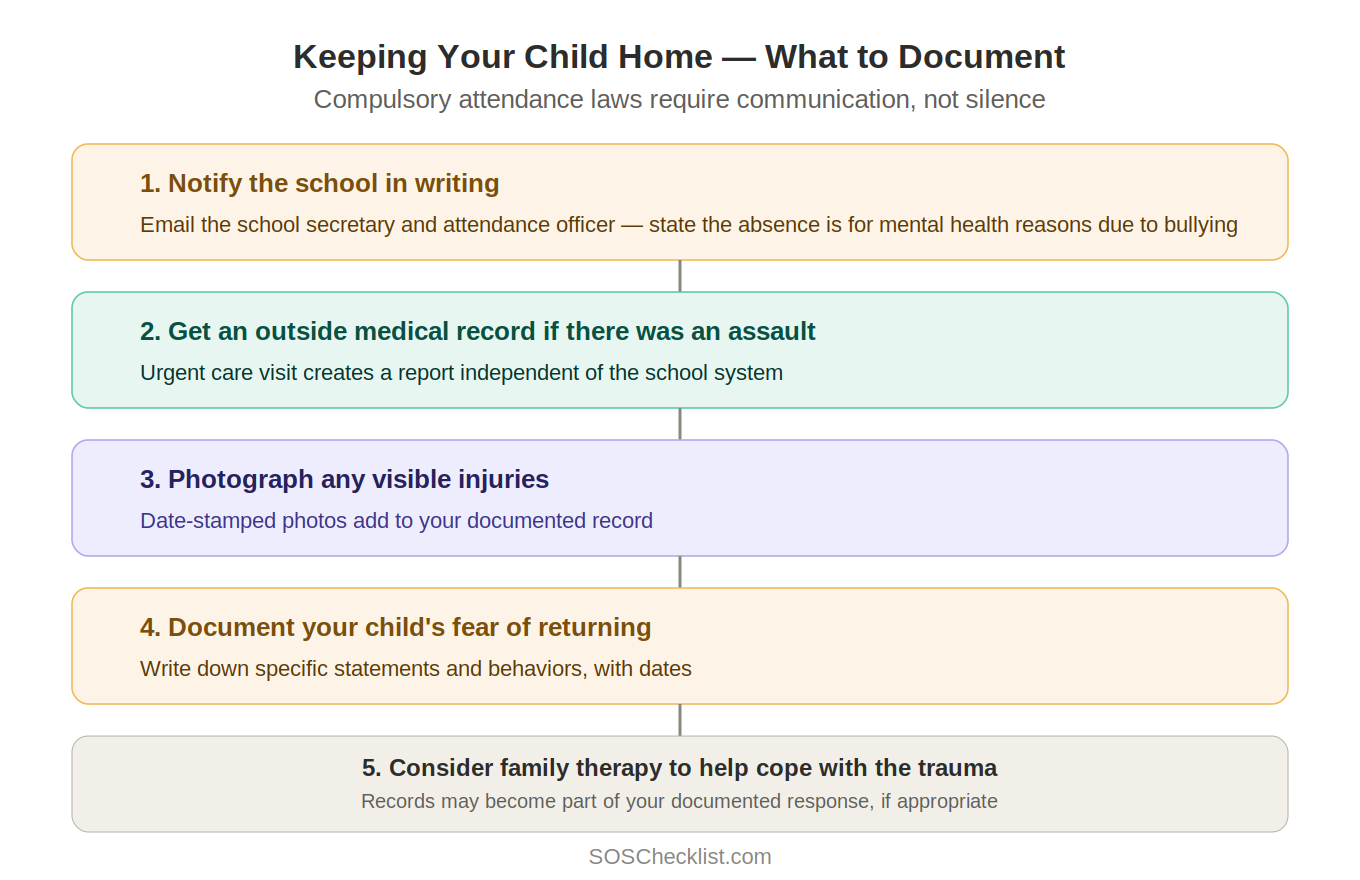
Because of compulsory attendance laws, parents must notify the school secretary and attendance officer — in writing, by email — that the student is staying home for mental health reasons due to bullying.
This is a specific and important detail: it should go to both the school secretary and the attendance officer, not just one or the other. And it should clearly state the reason — not a vague "my child is sick," but a direct statement that the absence is connected to bullying and your child's mental health and safety.
That written notice becomes part of your documented record. It is what transforms an unexplained absence into a communicated, reasoned decision.
Keeping Your Child Home — What to Document
If There Was a Physical Assault
If the reason your child does not want to return involves a physical assault, there are additional steps that matter, both for your child's wellbeing and for your documented record.
Take your child to urgent care for an outside agency medical report. This creates a record that exists independently of the school system — one that cannot be minimized or reframed by anyone at the school.
Take pictures of any bruises or visible injuries, with the date clearly noted. Document specifically if your child is too scared to return to school — their own words, their own behaviors, written down as close to the moment as possible.
And consider getting your entire family into therapy to help cope with the trauma. This is not just about your child. Bullying and its aftermath affect the whole household, and professional support can help everyone process what has happened.
Why This Documentation Matters Beyond the Attendance Question
Everything you document while your child is home does double duty. It protects you from any concern about attendance violations, and it becomes part of the broader record you may need if you escalate the bullying situation with the school district, request an emergency IEP meeting, or eventually need to demonstrate the impact of the bullying on your child's mental state and access to education.
This is why I encourage parents not to think of this as two separate tasks — managing the attendance question and managing the bullying response. They are the same documented record, built one piece at a time.
Mistakes I Would Avoid
1. Keeping your child home without notifying the school in writing.
This is the single biggest risk. An undocumented absence is what creates the appearance of a violation. Email the school secretary and attendance officer the same day, stating the reason clearly.
2. Being vague about the reason for the absence.
"My child isn't feeling well" does not create the record you need. State plainly that the absence is for mental health reasons connected to bullying.
3. Relying on a phone call instead of a written email.
A phone call to the school may feel sufficient at the moment, but it does not create the same documented record as a written notice. Follow up any phone call with an email the same day.
4. Not seeking outside medical documentation after a physical assault.
A school's internal incident report is not the same as an independent urgent care or medical record. If your child was physically hurt, get that outside documentation.
5. Waiting too long to address school refusal.
If your child's resistance to returning continues for more than a few days, this is the moment to formally connect the absence to a documented bullying report and, if applicable, an IEP or 504 safety conversation.
Questions to Ask Before Keeping Your Child Home
Have I notified both the school secretary and the attendance officer in writing, by email?
Did my email clearly state that the absence is for mental health reasons connected to bullying?
If there was a physical assault, have I obtained an outside medical record?
Am I documenting my child's specific statements and behaviors related to their fear of returning?
Is this absence connected to a bullying report I have already filed — or do I need to file one now?
When Outside Help May Be Appropriate
If your child's school refusal continues for an extended period, or if you are unsure how your specific state's compulsory attendance laws apply to your situation, consulting with a qualified attorney familiar with education law in your state is an appropriate step.
A school safety or bully consultant can help you organize your documentation and prepare for a conversation with the school about a safe return plan, alternative arrangements, or further accommodations.
Given the emotional weight of school refusal connected to bullying, connecting your child and your family with a qualified mental health professional is an important parallel step, not a separate concern.
If your child is in any immediate danger or expressing thoughts of self-harm, contact emergency services or the 988 Suicide & Crisis Lifeline right away.
Take the Safety Over Silence Checklist
Before you decide on your next step, take the Safety Over Silence Checklist at SOSChecklist.net. It can help you organize your documentation, identify what communication you still need to send to the school, and prepare for the conversation ahead.
Disclaimer
The Student Readiness Checklist and Safety Over Silence content are educational resources only. They do not provide legal, medical, mental health, therapeutic, or crisis advice; determine whether a school or individual violated the law; guarantee a particular outcome; or create an attorney-client, therapist-client, or other licensed professional relationship. Laws, school policies, and procedures vary by jurisdiction and circumstance. Consult an appropriately qualified professional regarding your specific situation. If a child is in immediate danger, contact emergency services or the appropriate local authority. If a child is experiencing a mental health crisis or expressing thoughts of self-harm, call or text 988 in the United States or seek immediate qualified help.
Frequently Asked Questions
Will keeping my child home from school make it look like I am violating attendance laws?
Whether it looks like a violation depends entirely on how you document and communicate the absence with the school. Notify the school secretary and attendance officer in writing, stating clearly that the absence is for mental health reasons connected to bullying. Clear, written communication is what distinguishes a documented decision from an unexplained absence.
Who should I notify if I'm keeping my child home due to bullying?
Notify both the school secretary and the attendance officer by email. State directly that your child is staying home for mental health reasons related to bullying. This creates a documented, timestamped record of your communication.
What should I do if my child was physically assaulted and won't return to school?
Take your child to urgent care for an outside medical report independent of the school system. Photograph any visible injuries with the date noted. Document specifically if your child is too scared to return, and consider family therapy to help process the trauma.
Is a phone call enough to notify the school about an absence related to bullying?
A phone call may feel sufficient at the moment, but it does not create the same documented record as a written email. Always follow up any phone conversation with a same-day email to the school secretary and attendance officer.
How long can I keep my child home before it becomes a legal issue?
This varies significantly by state and district, and depends on your specific circumstances. If school refusal continues for an extended period, consult a qualified attorney familiar with your state's compulsory attendance laws for guidance specific to your situation.
How can the Safety Over Silence Checklist help with school refusal situations?
The Safety Over Silence Checklist at SOSChecklist.net helps parents organize their documentation, identify what communication still needs to be sent to the school, and prepare for the conversation ahead regarding their child's safety and return to school.
Is this article legal advice?
No. This article is educational content only. It does not constitute legal, medical, mental health, or crisis advice, and does not create any professional relationship. Compulsory attendance laws vary by jurisdiction. Consult a qualified attorney or other appropriate licensed professional for guidance specific to your situation.
When should I get a mental health professional involved if my child won't go back to school?
If your child is experiencing significant fear, anxiety, or trauma related to bullying, connecting with a qualified mental health professional is an important step that should run alongside your documentation and communication with the school — not after it.
References
StopBullying.gov — Bullying and School Climate: https://www.stopbullying.gov/resources/parents
U.S. Department of Education — School Safety: https://www.ed.gov/school-safety
California Department of Education — Attendance and Truancy: https://www.cde.ca.gov/ls/ai/cw/ (URL should be verified before publication)
Oklahoma State Department of Education — Compulsory Attendance: https://sde.ok.gov/safe-schools (URL should be verified before publication)
988 Suicide & Crisis Lifeline: https://988lifeline.org